
Understanding the Need for Professional Party Sound Rental Woodstock Ga
When you host a celebration in Woodstock, Georgia, the right audio can turn a simple gathering into a memorable experience that guests talk about for weeks. Clear speech, balanced music, and reliable microphones help announcements, toasts, and entertainment flow without interruption. Many homeowners underestimate how quickly outdoor spaces absorb sound, especially when trees, grass, and open yards create natural dampening. A professional party sound rental Woodstock ga solution provides speakers, mixers, and wireless mics that are sized for the venue, ensuring every word is heard and every beat feels right. By investing in a dedicated sound package, you avoid the frustration of uneven volume, feedback, or equipment that fails mid‑event, letting you focus on enjoying the celebration with family and friends.
In Cherokee County, backyard parties often range from intimate family barbecues to larger quinceañeras or community reunions, each with different acoustic demands. A small group of 20 guests may need only a compact speaker and a handheld mic, while a gathering of 120 people benefits from a pair of full‑range speakers, a subwoofer for depth, and multiple wireless microphones for speeches and performances. Understanding these variations helps you choose a package that matches both the headcount and the layout of your yard. The goal is to create an even sound field where guests near the edge of the patio hear the same clarity as those gathered near the dance floor, making the event feel cohesive and inclusive from start to finish.
Assessing Your Guest Count and Space Requirements
Begin by determining the exact number of attendees you expect, as this figure drives many technical decisions. For a seated dinner, each person typically occupies about ten square feet, while a standing cocktail style may need closer to six square feet per guest. Multiply your guest count by the appropriate factor to estimate the total area required for dining, dancing, and mingling. In Woodstock yards, a common layout places the dining zone near the house, the dance floor in the central lawn, and a lounge area under shade trees, so you must verify that each zone fits within your property boundaries while leaving room for equipment cables and speaker stands.
Once you have the area estimate, map out where the main speakers will sit. Ideally, speakers are elevated on stands at least six feet high and positioned to cover the listening zone without pointing directly at walls or fences that can cause reflections. For a guest list of up to 50, a single pair of speakers placed 12 feet apart can deliver even coverage; for 51‑100 guests, consider adding a third speaker or a small fill unit aimed at the far end of the yard. When the count exceeds 100, a stereo pair supplemented by a subwoofer and additional side‑fill speakers helps maintain consistent volume across a larger footprint, preventing dead spots where speech becomes muffled.
Choosing the Right Sound Equipment for Woodstock Backyards
Selecting gear that matches the environment is crucial for reliability and sound quality. Look for powered speakers that include built‑in amplifiers, as they simplify setup by eliminating the need for external amp racks. Weather‑resistant cabinets protect the drivers from dew and occasional splashes, which is useful for evening events when humidity rises. Wireless microphone systems operating in the UHF band offer clear transmission and minimal interference, ideal for multiple speakers or performers who need to move freely across the lawn. Additionally, consider choosing mixers with built‑in Bluetooth or USB playback options, which let you stream playlists directly from a smartphone or laptop without extra adapters.
For Woodstock’s typical backyard dimensions, a configuration of two 12‑inch powered speakers with a 10‑inch subwoofer provides sufficient punch for music while keeping vocals crisp. If you plan to host live acoustic sets or a small band, add a pair of stage monitors so musicians can hear themselves without relying on the main PA. Remember to check battery life or power draw of wireless mics; having spare batteries or a small power strip nearby ensures the microphones stay live throughout the ceremony, speeches, and any surprise performances.
Setting Up the Sound System: Timeline and Step‑by‑Step Guide
Begin the installation at least two hours before the scheduled start time to allow for testing and adjustments. First, unload the speaker stands, speakers, mixer, and wireless mic kits from the vehicle and place them near the power source. Assemble the stands, extend them to the desired height, and secure the speakers with the supplied safety clips. Run the speaker cables to the mixer, keeping them coiled neatly to avoid tripping hazards, and connect the mixer’s main outputs to the speaker inputs. Label each cable with colored tape corresponding to its destination (mixer, monitor, subwoofer) to speed up troubleshooting if a connection becomes loose during the event.
Next, plug the mixer into a grounded outlet or a generator if the yard lacks sufficient power. Turn on the system and set the mixer’s gain structures to unity, then play a familiar track at moderate volume to check coverage. Walk the listening area while a friend speaks into a wireless mic; adjust the speaker angle and EQ until speech is intelligible everywhere. Once satisfied, label the mic channels, set the mixer to snap‑shots for different phases of the event (ceremony, dinner, dancing), and conduct a final sound check with the actual MC or DJ to confirm levels.
Yard Preparation: Power, Placement, and Safety Checks
Power availability often dictates where you can locate the sound gear. Most residential outlets in Woodstock provide 120‑volt, 15‑amp circuits, which can comfortably run a small PA system. If your setup includes multiple speakers, a subwoofer, and lighting, calculate the total wattage and ensure it stays below 80 percent of the circuit’s capacity to avoid tripping breakers. Using a heavy‑duty extension cord rated for outdoor use reduces voltage drop over longer distances, and a surge protector adds an extra layer of safety for sensitive electronics.
Speaker placement should respect both acoustics and safety. Keep speakers at least three feet away from pool edges, grills, or fire pits to prevent water damage or heat exposure. Secure all stands with sandbags or weights, especially if the ground is soft from recent rain, to stop them from tipping over when guests bump into them. Run all cables along the perimeter of the yard or under protective covers, and tape down any sections that cross walkways to eliminate tripping hazards. A quick walk‑through with a flashlight before guests arrive helps you spot any loose cords or unstable equipment.
Weather Contingencies: Rain Plan and Wind Protection
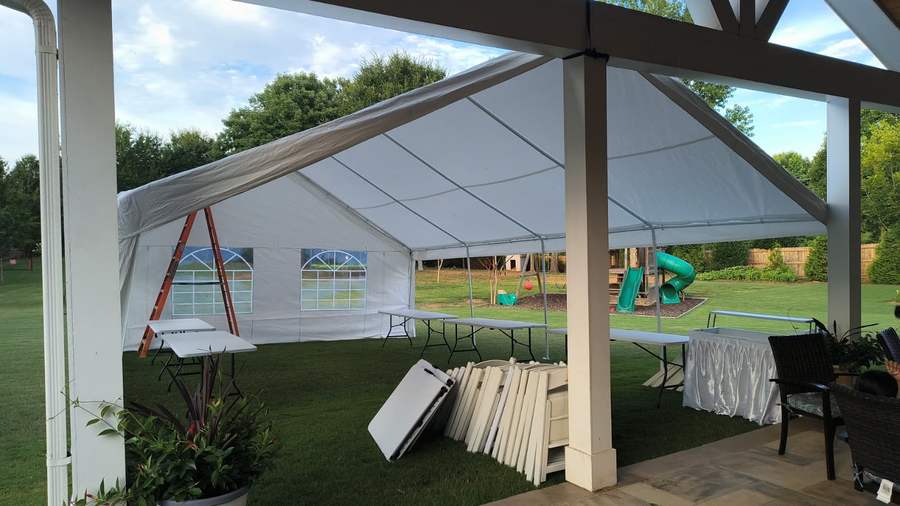
Even with a clear forecast, Georgia weather can change quickly, especially in the spring and summer months. Having a rain plan protects both your guests and your audio equipment. Sidewall panels for tents can be added to shield the speaker stacks from moisture while still allowing sound to project outward. If you anticipate heavy rain, consider relocating the PA to a covered patio or garage space that still offers line‑of‑sight to the listening area, using longer speaker cables or wireless audio transmitters to maintain coverage.
Wind can also affect speaker performance by causing the
Guest‑Count Math: How Attendees Shape Your Sound Needs
Translating headcount into audio requirements starts with simple multiplication. For a seated arrangement, multiply the number of guests by ten square feet to get the minimum floor area. For a standing cocktail layout, use six square feet per person. This baseline helps you decide whether a compact PA or a full‑range system is necessary. Keep in mind that extra space is needed for service tables, buffet lines, and dance floors, so add a ten‑percent buffer to the calculated area.
Seated vs Standing Calculations
Seated events such as dinners or receptions benefit from focused speaker placement near the dining zone, because conversation levels are lower and clarity is paramount. Standing events like dance parties or concerts require broader coverage, as guests move freely and the sound field must stay even across a larger footprint. By comparing the two calculations, you can decide whether to prioritize front‑fill speakers for speech or side‑fill units for music dispersion.
- Up to 30 seated guests – one main speaker pair plus a single wireless mic
- 31‑70 seated guests – add a second mic and a small monitor for the head table
- 71‑120 seated guests – consider a third speaker for balanced coverage
- Standing crowds up to 50 – a stereo pair with a subwoofer
- Standing crowds 51‑100 – add two side‑fill speakers aimed at the perimeter
- Standing crowds over 100 – a full PA with subwoofer, four side‑fills, and at least four wireless mics
Load‑In Timeline: From Truck to Test
A smooth load‑in prevents delays and reduces stress on the day of the event. Start by confirming the delivery window with the rental team, then stage all equipment near the vehicle for quick access. Having a clear plan for each step keeps the crew coordinated and ensures the system is ready well before guests arrive.
Two‑Hour Window Breakdown
First twenty minutes: unload speaker stands, speakers, mixer, and mic kits; place them close to the power source.
Next thirty minutes: assemble stands, secure speakers, run cables, and label each run with colored tape.
Following twenty minutes: connect power, set initial gain, play a test track, and walk the listening area to verify coverage.
Final thirty minutes: fine‑tune EQ, set scene snapshots for ceremony, dinner, and dancing, and run a final check with the MC or DJ.
- Confirm power availability and locate the nearest outlet or generator
- Check that all cables are free of knots and have appropriate length
- Verify that wireless mic frequencies are clear of local interference
- Ensure safety clips and sandbags are in place before tightening stands
- Keep a flashlight handy for evening inspections
Optimizing Yard Layout for Sound and Safety
Beyond power and placement, the physical arrangement of furniture, foliage, and pathways influences both acoustics and guest safety. Thoughtful layout decisions reduce echo, prevent equipment hazards, and create comfortable zones for dining, dancing, and mingling.
Speaker Stands and Cable Routes
Position speaker stands on stable ground, using sandbags or weighted bases if the soil is soft. Aim the main speakers slightly downward toward the listening area to minimize sound loss over distance. Run all cables along the yard’s perimeter or under protective rubber covers, securing them with tape where they cross walkways. Avoid running cables near water sources or open flames to prevent accidents.
- Place the mixer on a dry, level surface away from direct sunlight
- Keep spare batteries and a small power strip within arm’s reach of the mic station
- Label mic channels clearly so the MC can switch quickly between speech and music
- Arrange seating so that no guest is directly behind a speaker stack
- Leave at least a three‑foot clearance around each speaker stand for airflow
Local Logistics: Permits, Noise Rules, and Access in Woodstock
Understanding municipal guidelines helps you avoid surprises on the day of the event. Woodstock and Cherokee County have specific noise ordinances, parking considerations, and access requirements that affect setup times and equipment choices.
Checking Cherokee County Guidelines
Review the county’s noise curfew, which typically limits amplified sound after a certain hour in residential zones. Verify whether a temporary use permit is needed for large tents or equipment that blocks a driveway. Confirm that the rental vehicle can access your street without violating any weight or size restrictions, especially in neighborhoods with narrow lanes or low‑hanging branches.
- Contact the Woodstock Planning Department for any special event permits
- Confirm the allowed decibel level for outdoor amplified sound
- Check if a road closure notice is required for equipment delivery
- Ensure that the rental truck can park legally near the work zone
- Verify that any sidewalks or public rights‑of‑way remain unobstructed
Final Checklist: Ensuring Everything Is Ready Before Guests Arrive
A concise checklist guarantees that no detail is overlooked. Run through each item shortly before the scheduled start time, marking them off as completed. This practice reduces last‑minute surprises and lets you focus on enjoying the celebration.
- Power source tested and voltage within safe limits
- All speakers secured on stands with safety clips engaged
- Speaker cables labeled, taped down, and free of tripping hazards
- Wireless mic batteries fresh and spares available
- Mixer gain set to unity and scene snapshots programmed
- Speaker angles adjusted for even coverage across the listening zone
- Subwoofer positioned to avoid excessive bass buildup near walls
- Any tent sidewall panels installed if rain is forecast
- Safety walk‑through completed: no loose cords, stable stands, clear walkways
- Local noise ordinance checked and event end time compliant
- Access route for delivery vehicle confirmed and clear